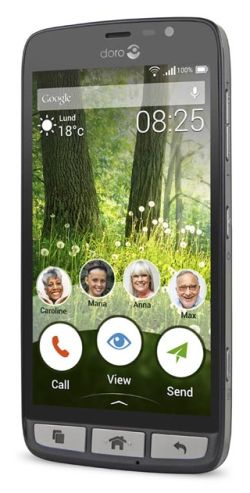
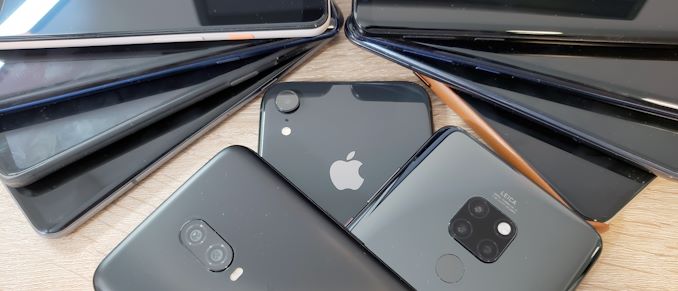
i-mate Ultimate 8502 - Full phone specifications
The name might not be immediately familiar, but if you’ve ever used an Amazon Echo speaker then you’ve benefited from its technology. XMOS is a fabless semiconductor company specializing in voice processing. Its algorithms are capable of detecting softly-spoken voice commands from across a room – even in challenging conditions (like rooms with a lot of hard surfaces). So why has voice taken off so rapidly? ALEX CRACIUN, XMOS “I think it makes life easier,” says Alex Craciun, algorithm engineer at XMOS. “You don’t have so many cables and complicated instructions that you have to take care of. You can just give commands and the device tunes itself, or tells you something that you want it to. That’s a lot easier.

” “I play IT support to my parents, and we think voice is going to end that, because your technology will tell you how it works,” adds director of corporate marketing Esther Connock. “It won’t need to come with a remote; it won’t need to come with an instruction booklet – you just talk to it in a very natural, conversational way, and that for us democratizes technology because you don’t need to learn how to use it. You don’t need to come at it with knowledge. “So if you think about people with low literacy or low levels of education, suddenly it’s a much more open playing field. Vulnerable sectors of society can use technology and become less isolated. So for us, voice is the most natural thing in the world.
i-mate Ultimate 8502 - Full phone specifications - Core Criteria Of accessories for smartphones - The Basics
” It’s good to talk XMOS part of the blossoming tech industry in Bristol emerging from the city’s two universities, which also includes Ultrahaptics (which uses ultrasound to create a sensation of touch in mid-air), Reach Robotics (creator of the Mekamon augmented reality robot) and Graphcore (a spin-off from XMOS). ESTHER CONNOCK, XMOS Its speech detection and isolation tech includes beamforming (which tracks a person’s voice as they move around a room and moves the microphone to follow them), acoustic echo cancelation (separating the user’s voice from sound being played by the device itself), deverberation (compensating for echoes), noise suppression, barge-in (which stops audio playback when the device’s wake-word is detected), and fixed or automatic gain control (ensuring all voices in conference calls are heard at the same volume, regardless of how loudly the person is speaking). The company was founded in 2005, built on re from the University of Bristol. “They developed a micro-controller that could do a lot of processing, had a lot of power and capability, and could perform a lot of tasks concurrently,” explains Connock, “so that was hugely exciting.” Apple’s decision to kill off the FireWire port in 2008 opened up the market for USB audio, where XMOS found its niche.
Compared - Fast Programs In smartphone - i-mate Ultimate 8502 - Full phone specifications
The company diversified, working for big players like Harmon Kardon and Yamaha, but also for DJs with their mixing decks, before turning to multi-channel audio. “With a board with a lot of processing power, we could produce something with up to 32 channels of output, so we could get fantastic multi-channel audio,” explains Connock. “And that specialism in sound and audio led us into voice as it started to emerge.
One of our clients said, ‘With all your expertise, you should be thinking about microphones and capturing voice.’ And that’s exactly what we did.” For us [voice] democratizes technology because you don’t need to learn how to use it Esther Connock, XMOS In 2017, XMOS gained Amazon certification for its far-field voice interface. “We’re still their only qualified partner with a stereo solution, so for anyone developing TVs and soundbars and set-top boxes and doing work in true stereo, we’re the only provider that can do acoustic cancelation in stereo,” says Connock.



No comments:
Post a Comment